

BLOG
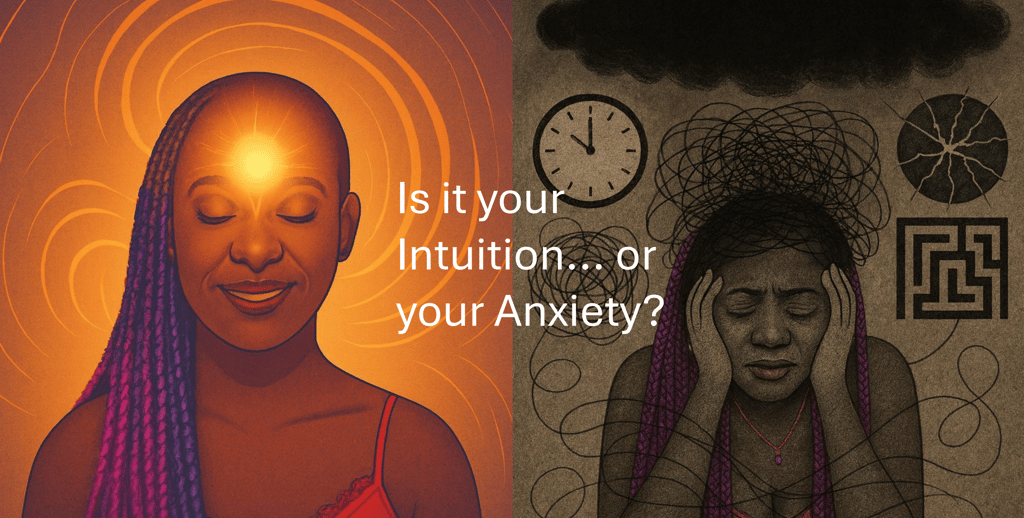
The Internal Compass: A Clinical Psychologist and Reiki Master’s Guide to Telling Anxiety from Intuition. By Dr Akpevwoghene Claire Wiles | 08.02.2026.
We have all been there: A sudden "gnawing" in the pit of your stomach. A recurring thought that tells you to turn left instead of right, or to say "no" to that shiny new job offer.
In that moment, a vital question arises: Is this my inner wisdom protecting me, or is it my nervous system reacting to old trauma?
Distinguishing between Anxiety and Intuition is one of the most transformative skills you can develop. As both a clinical psychologist and an energy healer, I look at this through two lenses—the brain’s survival mechanisms and the soul’s energetic frequency.
The Psychology of the "False Alarm"
From a clinical perspective, Anxiety is often the brain’s "smoke detector" going off when there isn't actually a fire.
When we experience anxiety, our sympathetic nervous system kicks into gear. The amygdala—the brain's emotional processing centre—sounds the alarm, flooding our bodies with cortisol and adrenaline. This creates a state of contraction.
The Language of Anxiety: It is repetitive, frantic, and loud. It uses "Shoulds," "Musts," and "What-ifs."
The Physicality: It usually manifests as a tight chest, shallow breathing, or a "buzzing" restlessness in the limbs.
The Energetic Frequency of Knowing
Intuition, on the other hand, operates on a much higher, subtler frequency. In energy-based approaches, Intuition is seen as an alignment between your heart and your third eye.
Unlike anxiety, intuition is expansive. Even if the message it brings is uncomfortable (like realising a relationship needs to end), it carries a profound sense of "rightness" or "click."
The Language of Intuition: It is calm, neutral, and brief. It doesn’t argue or try to convince you; it simply states a fact.
The Physicality: It often feels like a "dropping" into the centre of the body, a grounded gut feeling, or a sense of sudden clarity.
The Comparison: How to Tell the Difference
Feature: Anxiety (The Critic)
Tone: Critical, harsh, or fearful
Focus: Future-based (fear of outcomes)
Energy: Contrictive, tight, or "heavy"
Duration: Loops and ruminates for hours
Feature: Intuition (The Compass)
Tone: Neutral, compassionate, or detached
Focus: Present-based (immediate "knowing")
Energy: Expansive, clear, or "steady"
Duration: A flash of insight that remains still
A Practice to Find Your Answer
If you are struggling to tell which voice is speaking, I invite you to try this Somatic Energy Check:
Find Stillness: Sit quietly for two minutes. Place your left hand on your heart and your right hand on your solar plexus (just above the navel).
Invite the Thought: Bring the situation to mind.
Observe the Shift: Does your body lean forward or pull back? Do your muscles tighten (Anxiety) or do you feel a sense of "settling" (Intuition)?
Clear the Static: If the energy feels muddy, visualise a golden or white light coming into your body from the top of your head and going all the way down through your toes and into the ground. Doing this helps with clearing your energy field.
Often, once the "static" of anxiety is cleared, the quiet voice of intuition is all that remains.
Moving Forward
Learning to trust yourself is a journey of both the mind and the spirit. By honouring your psychological triggers and clearing your energetic blockages, you create the space for your true inner guide to lead the way.
References
Stein, D. J. (2006). Advances in understanding the anxiety disorders: the cognitive-affective neuroscience of ‘false alarms’. Annals of Clinical Psychiatry, 18(3), 173-182.
Quest, P. (2010). The Reiki Manual: A Training Guide for Reiki Students, Practitioners and Masters. Piatkus.
Beyond the Roses: Finding Love, Connection, and Hope When Your Heart Aches on Valentine's Day. By Dr Akpevwoghene Claire Wiles | 14.02.2026.
On Valentine’s Day the world explodes in a symphony of red hearts, sweet chocolates, and declarations of romantic love. For many, it's a cherished occasion to celebrate connection. But for a significant number of people, this day can arrive with a quieter, heavier emotional landscape.
If you are navigating Valentine's Day with the ache of a loved one's absence, the sting of loneliness, or the profound weight of grief, please know this: You are not alone, and your feelings are entirely valid.
As a clinical psychologist, I frequently observe how festive periods, rather than being purely joyful, can act as potent emotional amplifiers. They create a contrast, starkly highlighting what – or who – is missing from our lives. This can trigger a fresh wave of grief, loneliness, or even a sense of disconnection, even if we thought we had processed these feelings. It is a normal, human response to loss and absence, and it speaks to the depth of our capacity to love.
The Psychology Lens: Honouring the Waves of Grief and Loneliness
Grief, as we know clinically, is not a linear process. It doesn't move neatly from one stage to the next, especially not on a calendar's command. Valentine's Day can be a potent grief trigger, bringing memories, traditions, and the raw feeling of "what was" sharply into focus.
Loneliness, too, is a complex emotion. It’s not simply about being physically alone; it's the painful perception that our social connections are inadequate. On a day dedicated to connection, this feeling can be acutely painful.
What to remember from a psychological perspective:
Validation is Key: Your feelings are valid. There's no "right" or "wrong" way to feel today. Allow yourself the space to experience whatever emotions arise without judgment.
Self-Compassion is Crucial: Be kind to yourself. You wouldn't tell a friend in pain to "just get over it." Extend that same grace inward.
Routine vs Flexibility: While routine can be grounding, give yourself permission to deviate if needed. If your usual Valentine’s Day traditions feel too painful, create new, gentle ones for today.
The Spiritual Lens: Love Transcends the Veil
Looking beyond my clinical understanding, my work as a spiritual guide and Reiki Master offers a profound truth: Love is an energetic force that transcends physical boundaries.
If you have lost a loved one, especially on a day celebrating love, the pain can feel immense. From a spiritual perspective, I believe that death is not an ending. It is a transformation. The physical form may be gone, but the energetic imprint, the essence of that soul, and the love shared, remain.
Your connection with those who have passed is not severed; it shifts. It moves from a physical interaction to a spiritual one. They are not "gone" in the absolute sense, but exist in a different dimension, still interwoven with your energetic field. Many people find comfort and genuine connection through:
Signs: Noticing "coincidences," finding objects, or feeling a presence.
Dreams: Receiving messages or experiencing comforting visits in sleep.
Intuitive Knowing: A quiet certainty that they are near, sending love.
This understanding offers hope: the love that filled your life has not vanished; it has simply evolved. You are still connected, heart-to-heart, soul-to-soul.
Finding Hope & Connection: A Path for Today
So, on this Valentine's Day, whether you’re navigating grief, loneliness, or simply a quieter experience of the day, here are ways to connect – with those beyond, with those around you, and most importantly, with yourself:
Acknowledge and Allow: Sit with your feelings. If sadness or loneliness arises, don't push it away or ignore it. Acknowledge it gently, perhaps saying to yourself, "I feel sad today, and that's okay."
Ritual of Remembrance:Light a Candle - A simple act of lighting a candle can symbolise continuing love and connection.
Create a Sacred Space: Place a photo, an object, or a flower that reminds you of a loved one.
Write a Letter: write a letter to someone you miss, expressing your feelings. You don't need to send it; the act of writing is therapeutic.
Connect with the Living: Reach out to a friend, a family member, or even a supportive community online. Sometimes, simply sharing your feelings can lighten the load.
Engage in Self-Care: What would bring you genuine comfort today? A warm bath? Your favourite meal? A quiet walk in nature? Treat yourself with immense kindness. You are worthy of love, especially from yourself.
Tap into Your Inner Wisdom: Close your eyes, place a hand on your heart. Ask your inner self, "What do I need most today?" Listen to the quiet answer. This is your intuition speaking, guiding you toward healing and peace.
Valentine's Day, at its core, is about love. And love, in its broadest sense, is endless. It encompasses grief, celebrates joy, and binds us together, across all planes of existence. Even when the world feels loud with celebrations that don't match your inner experience, know that you are held, you are loved, and hope is always present, waiting to be rediscovered.

© Dr. Akpevwoghene Claire Wiles
Website designed and built by www.stylishwebsites.co.uk